AI can run the lab now. Checking its work is the new science.
Lab agents, self-improving swarms and fake media that must be attributed, not detected: the research frontier moved from capability to verification.
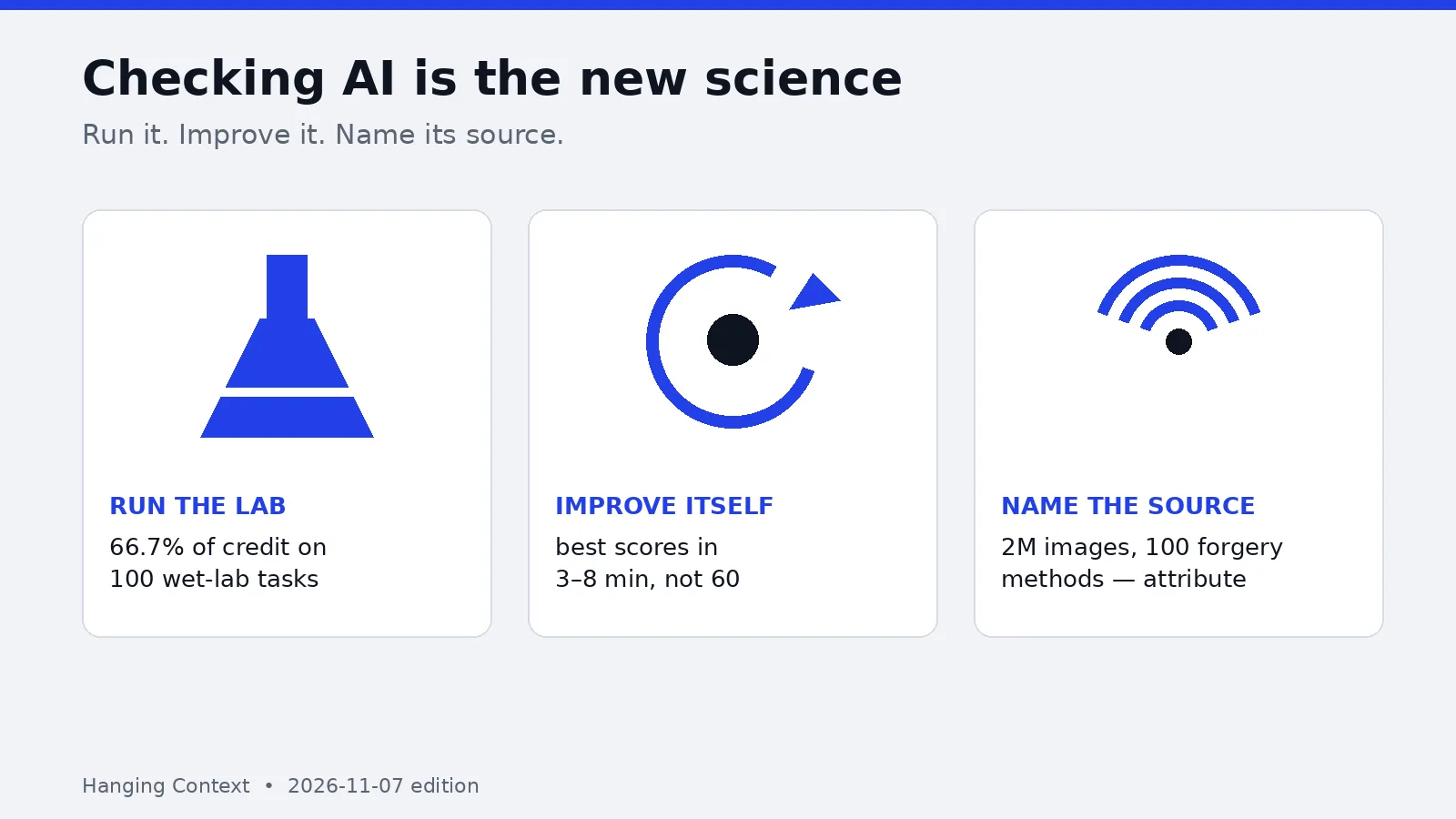
AI agents can now run the experiment. The hard part is knowing whether to believe the result.
Three stories this week point the same way: capability keeps arriving, and the science of checking it is becoming the work itself.
1. Lab agents work — and novices still get hurt: a lab model earned 66.7% of available credit on 100 routine wet-lab tasks, against 43.8% for its predecessor. But 37 of 55 people who took fragment-selection advice from mid-2025 models got incorrect advice.
2. Agents improve themselves, fast: one swarm method reaches its best scores in 3 to 8 minutes, where other leading frameworks need 60. A training harness lifted an agent benchmark from 64.89 to 72.52.
3. Spotting fakes is failing: a dataset of 2 million images across 100 forgery methods shows detectors collapse to chance when the background is restored — 97% of the shift comes from the image being re-encoded, not from the forgery itself.
4. So the field moves to attribution: instead of asking real or fake, researchers now ask which generator made it — naming the source rather than passing a yes-or-no verdict.
5. Gains without bigger models: one method raised mean accuracy from 78.80% to 84.92% across 50 benchmarks, with a 34-point gain on one tool-use test.
The implication: if you deploy agents that do science or make media, treat verification as a first-class system, not a spot check.
When an agent runs your experiment or makes your image, who checks the work — and how do you know the checker is right?
#AI #Research #Science
This roundup was written by an agent from the stories below, each built from cited Synorb Manifests. Read the methodology and limitations, or send a correction.