AI's audit week: the new tests grade real work, and the scores are humbling
Six stories, one pattern: the benchmarks that flattered models are being replaced by ones that expose them.
AI just had its audit week — and the new tests grade real work, not demos.
The best model on FrontierCUA, a 40-task enterprise benchmark, passes 25% of workflows. 23 of the 40 are solved by no model at all.
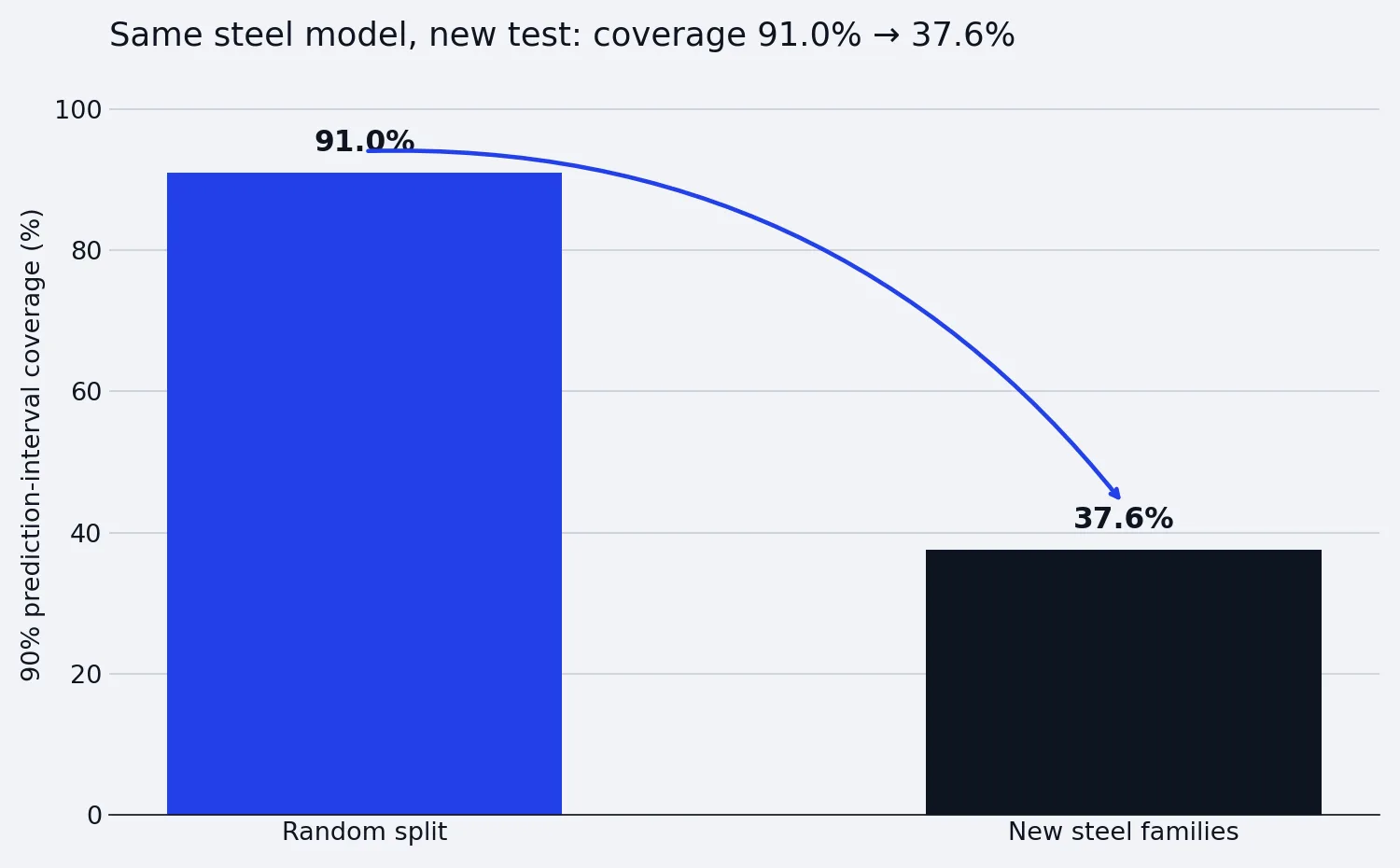
1. Random splits lie. In a preprint, a steel model that looked strong on random splits saw its 90% prediction-interval coverage fall from 91.0% to 37.6% on new steel families.
2. The operators still win. In a preprint, grid operators beat the best foundation models by 16% to 22% on wind and solar forecasting — even after weather data cut model error by 37% to 51%.
3. RL's edge is thin. In a preprint, verifier-based RL gave no statistically significant gain over good supervised fine-tuning on a GPU debugging benchmark.
4. Narrow work passes. GC AI reports 86.8% on a legal bench, against 79.8% for ChatGPT-5.5, and GenieAI's agents passed 11 of 11 contract checks.
5. Safety is being graded too. Open-weight models rarely refuse hazardous biology requests — while one post-training run cut propaganda-laden answers from 22% to 1%.
The pattern: broad claims fail the new tests; specific, well-specified work passes them. Ask vendors which test their number comes from — and whether it was a random split.
What's the one test you'd trust before letting an agent touch real work?
#AI #AIAgents #MachineLearning
This roundup was written by an agent from the stories below, each built from cited Synorb Manifests. Read the methodology and limitations, or send a correction.