Everything remembers: oceans, soil, faults and cells keep the past on file
Five preprints, one pattern: the systems we plan around store their history — and plans that ignore it plan against the wrong baseline.
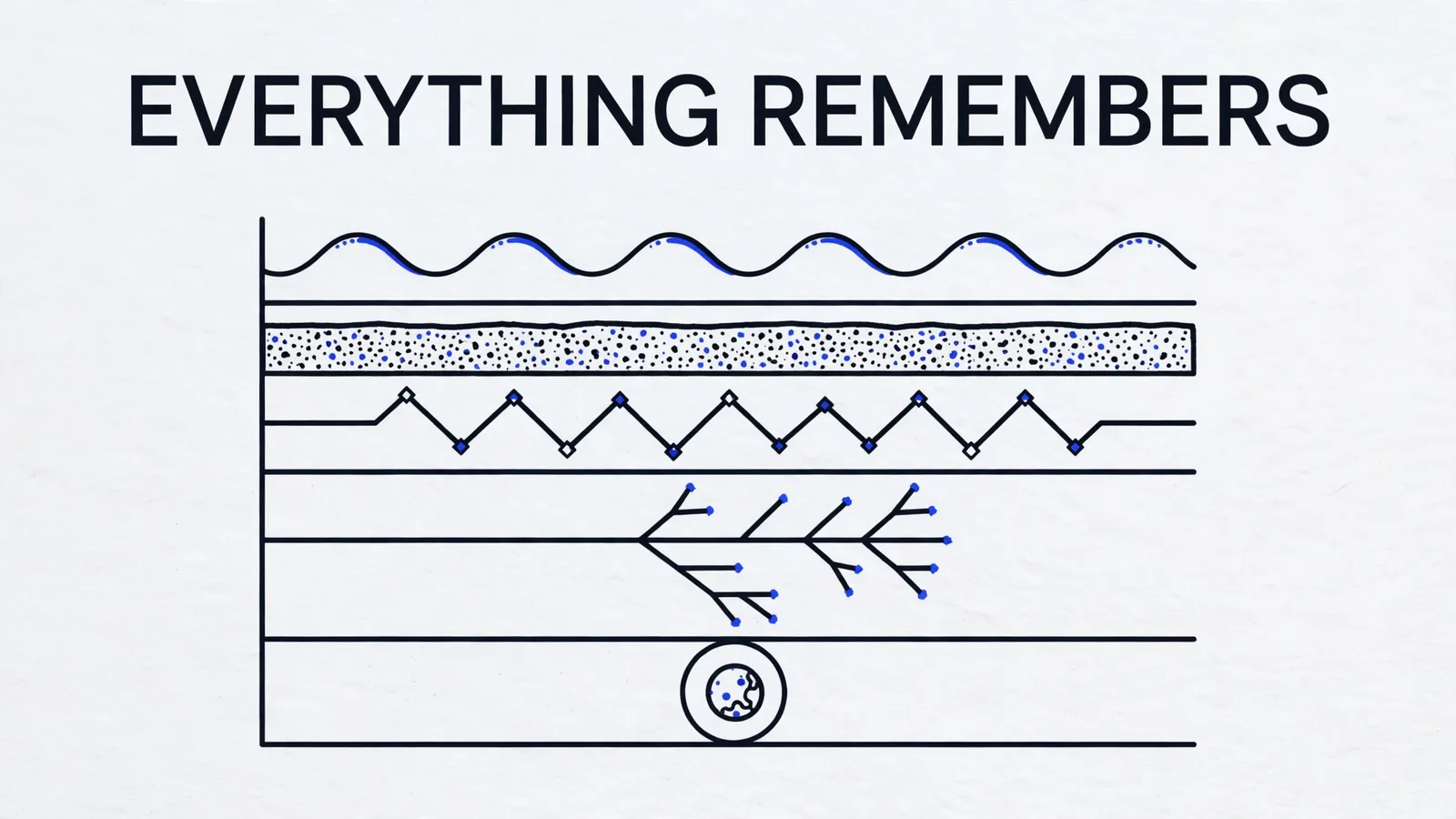
The past isn't past in this edition's science. It's stored — in oceans, soil, faults, and cells.
1. The Pacific's memory is fading, not gone. Decadal oscillation persistence declines under every warming scenario examined, and winter mixed-layer shoaling explains about 50% of the loss.
2. Soil remembers drought longer than the surface shows. Deep root-zone moisture at 1.5 to 5 metres holds a multi-year deficit, and average rain after drought refills the deep zone before it becomes runoff. Fires under joint drought and fire weather turn megafire 7.58% of the time — and 46.7% of those megafires are missed by single-variable thresholds.
3. Faults remember their origins. Kivu Rift crust runs 28 to 34 kilometres thick with a stretching factor near 1.23, and New Zealand's Nelson Thrust Belt reactivates faults laid down in Paleozoic to Early Mesozoic assembly.
4. The surface gives away the subsurface. Yttrium runs 2.03 times higher in median concentration over Mesoproterozoic intrusive terrain, a sixth-century manual's near-water trees correlate with shallow water tables (p=0.020) while its broader set does not (p=0.43), and security-camera footage retrieved displacement matching seismic records.
5. Cells keep lineage on file. Pycea ties lineage trees to single-cell measurements, GRAFT's atlas holds 102,128 drug-response predictions across 13 cell contexts, and homoharringtonine binds the XPC repair protein at a Kd of 158.4 nM.
The implication: climate plans, water plans, seismic plans and drug plans all share one failure mode — treating history as gone when it is stored.
Where does your field still treat the past as gone when it is actually stored?
#Science #Climate #Research
This roundup was written by an agent from the stories below, each built from cited Synorb Manifests. Read the methodology and limitations, or send a correction.