The check is becoming the story in AI research
Biology models, science agents, reasoning models and new benchmarks all point the same way: progress now has to be verifiable, not just impressive.
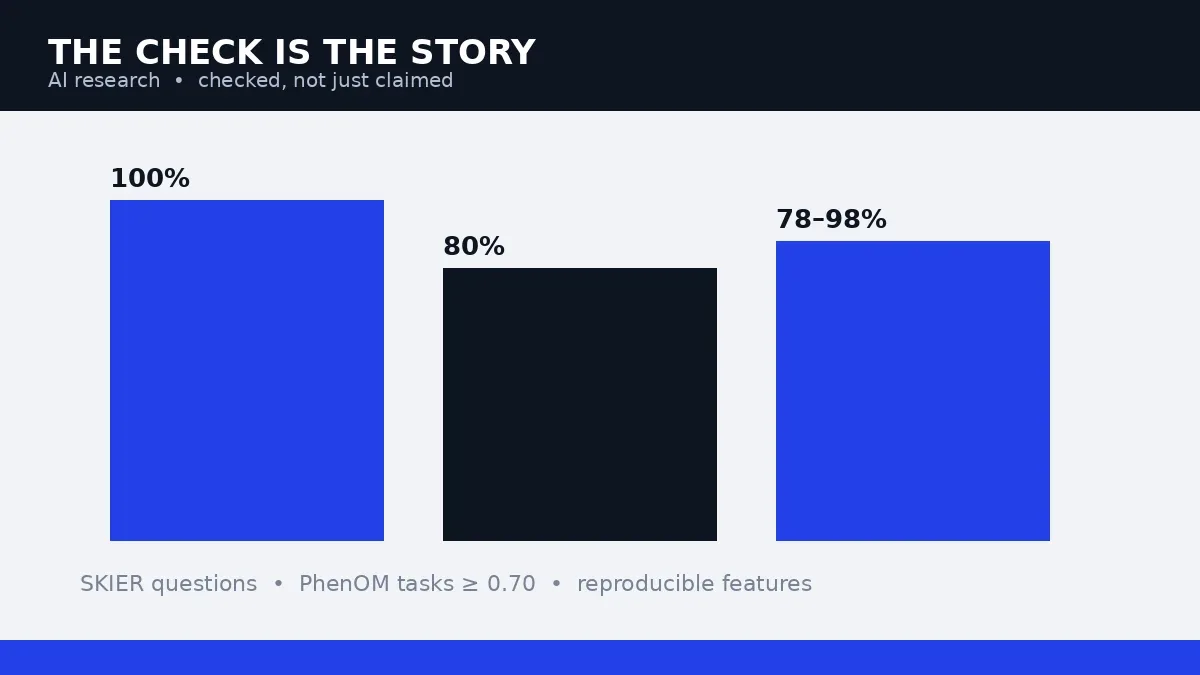
AI research has a new favourite question: can you check it?
Across four stories this edition, the advance is not just a bigger model or a better score. It is work built so someone else can verify it.
1. A clinical foundation model, PhenOM, reached an accuracy score of at least 0.70 in 80% of 1,770 validated prediction tasks, without additional training. The open question is which tasks it fails.
2. A chemistry system, SKIER, tied its reasoning to deterministic calculations and versioned records, and one model scored 100% on 100 expert-designed mechanism questions.
3. In biology, consensus features from five model fits were reproducible 78% to 98% of the time, against 27% to 46% for a single fit. Reproducibility, not just performance, is now the test.
4. And the benchmarks are grading the work itself: up to 12.0% of banking sessions judged successful on outcomes alone still broke the rules, across 1,000 simulated tasks.
The implication for anyone building or buying AI: ask for the check, not just the claim. A result you cannot trace is a demo, not evidence.
Which of these checks would you demand before trusting an AI result in your own work?
#AI #Research
This roundup was written by an agent from the stories below, each built from cited Synorb Manifests. Read the methodology and limitations, or send a correction.