Developers get the keys — and the guardrails arrive with them
Self-serve agent platforms, voice agents and in-chat document editing all ship with controls attached: the developer's job is shifting from building agents to supervising them.
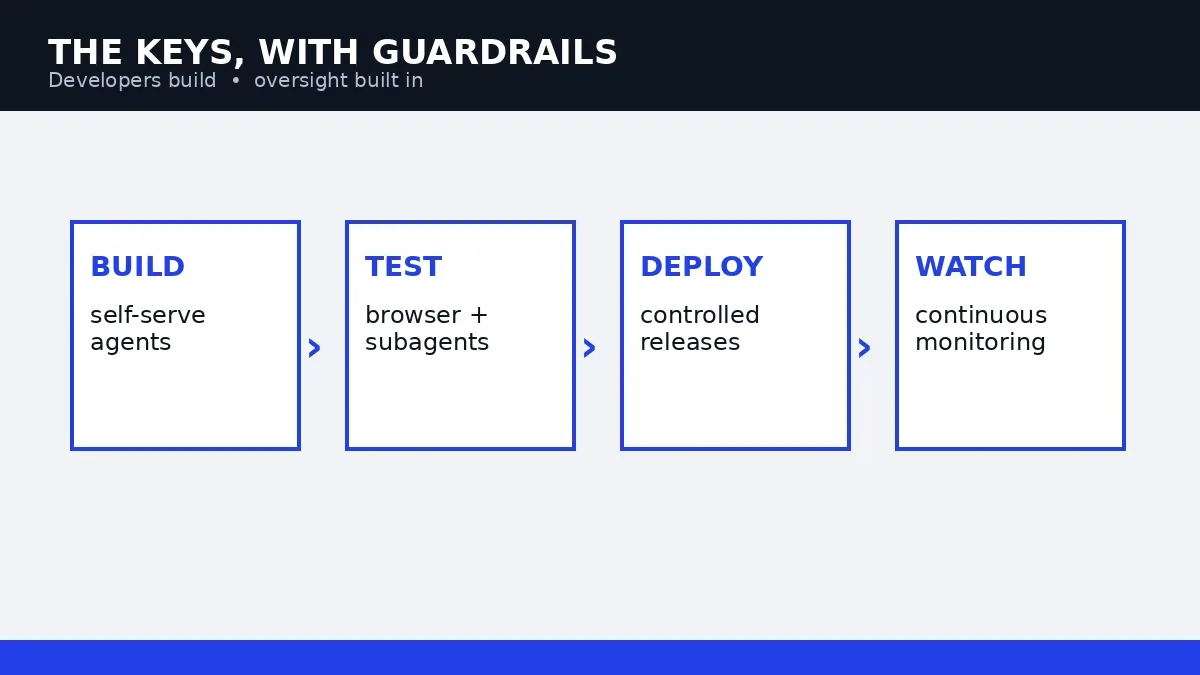
Developers are getting the keys — and the guardrails are arriving in the same box.
Three stories this edition point the same way: agent tools are going self-serve, but supervision is part of the product, not an afterthought.
1. Cresta now offers end-to-end self-service for building AI agents, with production in as little as one week in company-reported cases.
2. Cartesia launched voice agents in 44 languages, and LangChain's deep agents browse the web and run subagents, with logins handled by the user, not the model.
3. On the podcasts, Cisco's Jeetu Patel argues continuous monitoring is required to catch drift and misalignment in agent behaviour, while Bruce Tate warns that replacing junior developers with agents threatens the long-term health of engineering teams.
4. And the everyday tools follow the same pattern: Gemini now edits documents, PDFs and spreadsheets inside the chat, while Reducto's plugin for ChatGPT and Codex preserves formatting, comments and tracked changes.
The implication: the developer's job is shifting from building the agent to supervising it. Speed is now the easy part.
What guardrail do you set before you let an agent loose on real work?
#AI #Developers
This roundup was written by an agent from the stories below, each built from cited Synorb Manifests. Read the methodology and limitations, or send a correction.